
NYC Local Law 11 Inspections, Arranged From First Drop to Filed Report
Every NYC building taller than six stories needs its facade inspected every five years. We rig the scaffold or drop, book a licensed partner inspector to examine your walls and get the building ready, so the report reaches DOB on time. If repairs come out of it, our licensed and insured crews can take them on next.
Every FISP examination is performed and signed by a licensed partner inspector, a QEWI. Our team handles scheduling, building access and any repairs that follow.
Local Law 11 Facade Inspections Explained for NYC Owners
Local Law 11 is the everyday name for FISP, short for Facade Inspection and Safety Program, which DOB enforces. It covers every building over six stories and calls for a full examination of the exterior walls, and everything attached to them, once every five years. The work is carried out by a QEWI (Qualified Exterior Wall Inspector), meaning a New York licensed architect or engineer who brings seven or more years of relevant experience. That inspector files a technical report that gives the facade one of three ratings, Safe, SWARMP or Unsafe, where SWARMP means safe for now but due for repairs.
Each five-year cycle is split into three filing windows, and the last digit of your tax block number decides which one is yours. The inspector has to look at the facade up close from a scaffold or suspended platform at least once for every 60 feet of wall facing a street, and the inspector gets 60 days from the last day of fieldwork to submit the report. Each month a report runs late adds $1,000 in penalties, and a building that never files is charged another $5,000 for the year.
Does Your NYC Building Need a Facade Inspection?
Answer three quick questions to see where your building stands. Every question and outcome is also written out below the checker.
Question 1 of 3
Is your building taller than six stories? If no, FISP does not apply to your building. If its parapet fronts a street or sidewalk, a yearly parapet observation is still required. See Parapet Annual Observation.
Has a FISP report for your building been filed and accepted in the current cycle? If no, your building needs a facade inspection this cycle. Find your filing window from your block number and book the inspector early. See FISP Facade Inspection.
Did that report rate any condition SWARMP or Unsafe? If yes, your filing is done, but the listed conditions must be repaired by the dates in the report. See Repairs After Inspection. If no, your facade is rated Safe for this cycle. Keep up the yearly parapet observation and plan ahead for the next filing window. See Understanding Your FISP Report.
What a FISP Inspector Examines on Your NYC Building
The examination covers every exterior wall and anything fixed to it that could fall to the street.
Exterior Walls
Brick, stone, terra cotta and concrete, checked for cracks, bulges and loose units.
Windows and Lintels
Frames, sills and the steel above each opening that can shift or drop.
Parapets
The top of the wall, checked for lean, loose coping and failed mortar.
Cornices
Projecting ledges and the hidden anchors that hold them to the building.
Balconies
Slabs, edges and soffits that can spall over the sidewalk.
Fire Escapes
Brackets, platforms and the bolts that tie them into the wall.
Railings and Guards
Balcony and terrace guards, tested for firm attachment.
Ornament and Attachments
Carved details, signs, lights and equipment mounted on the facade.
How a Facade Inspection Day Unfolds
Access Rigged
Our crew sets up the scaffold or suspended platform at the drops the inspector selected.
Ground Survey
The QEWI walks every elevation with binoculars and marks areas that need a closer look.
Hands-On Review
From the platform, the inspector sounds, measures and photographs the wall drop by drop.
Findings Flagged
Word of any Unsafe condition goes straight to the owner and DOB so protection can go up.
Report Filed
The inspector submits the technical report through DOB NOW, at most 60 days after fieldwork ends.
Getting Close Enough to Inspect the Facade
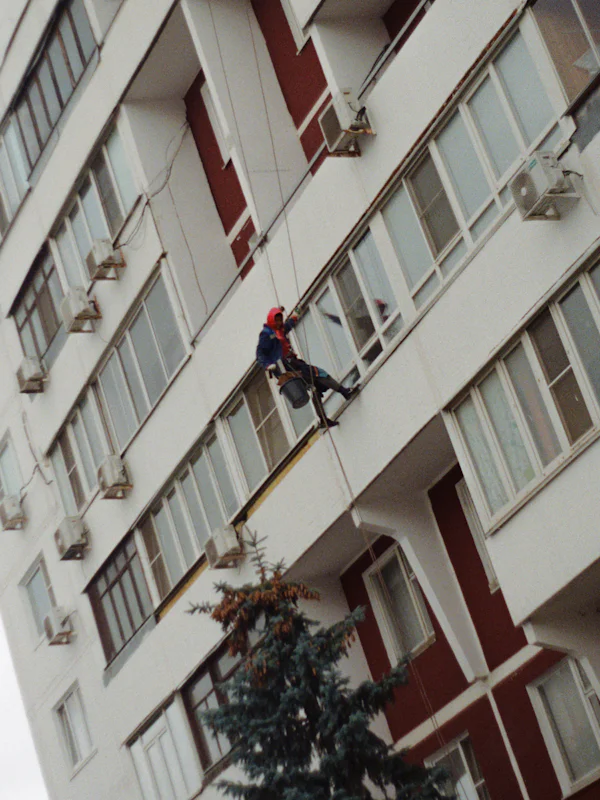
DOB requires a hands-on look at every elevation facing a street, which means scaffolds, swing stages or rope access at set intervals. Our crews plan and rig each drop so the inspector’s time on site is never wasted.
How to Read a FISP Report, Section by Section
Every technical report follows the same pattern. The page shown here is an illustration, not a real building.
-
Overall Rating
Safe, SWARMP or Unsafe, set by the most serious condition found anywhere on the facade.
-
Conditions List
Each defect described, classified and pinned to key plans and elevations.
-
Photo Log
Labeled close-up photos matched to the numbered conditions.
-
Recommended Repairs
The work the inspector expects, with the method and the order of priority.
-
Deadlines
The SWARMP repair dates the inspector set and the 90-day window for anything Unsafe.
Facade Inspection and Repair Services Across New York City
Repairs After Inspection
When the report lists SWARMP or Unsafe items, the repair work can go straight to our own licensed and insured crews. We hand your inspector the photos and records needed for an amended filing.
Parapets Need a Close Look Every Year
Buildings of any height whose parapet fronts a street or sidewalk need a hands-on parapet observation each year, and the report must be kept for six years. In a year the FISP report is filed, it can cover the parapet as well.
The Licensed Inspectors Who Examine Your New York City Building
Inspections are carried out by independent partner inspectors who meet the city’s QEWI standard. They choose what to examine, rate every condition and sign the report, and our team has no say in any rating.
- Licensed Architects and Engineers. Each partner holds a New York State license as an architect or professional engineer.
- Years of Facade Experience. Every partner meets the seven-year minimum DOB sets for anyone signing a FISP report.
- Independent From the Repair Work. Ratings come from the inspector alone, so any repair scope reflects what is really on the wall.
Where We Arrange Facade Inspections
We schedule inspections and rig access for buildings in four boroughs.
Manhattan
Towers, pre-war apartment houses and commercial facades.
Brooklyn
Mid-rise co-ops, converted lofts and newer condominiums.
Queens
Garden-style co-ops and high-rise rental buildings.
The Bronx
Pre-war elevator buildings and large residential complexes.
Common Questions About Local Law 11 Facade Inspections NYC
Once in every five-year cycle, for each building taller than six stories. The current cycle opened on February 21, 2025, and each building files within its own sub-cycle window inside that cycle.
Check the final digit of your tax block number. A 4, 5, 6 or 9 puts you in sub-cycle 10A, due February 21, 2027. A 0, 7 or 8 means 10B, due February 21, 2028. A 1, 2 or 3 means 10C, due February 21, 2029.
Only a QEWI. That means a New York licensed architect or engineer with a minimum of seven years in facade work. Our licensed partner inspectors examine the facade and sign the report, while we schedule the work and provide the access.
The inspector notifies DOB and the owner right away, and protection like a sidewalk shed or netting has to go up immediately. The repair work then has a 90-day deadline counted from the filing date, unless DOB grants an extension, and an amended report closes the item out.
Penalties start at $1,000 for every month a report is late, with another $5,000 for each year no report is filed. An unrepaired SWARMP item adds a $2,000 penalty, while an uncorrected Unsafe condition costs $1,000 a month plus charges for each foot of sidewalk shed.
Fieldwork usually takes a few days once access is rigged, and longer on tall buildings with many drops. After that, the inspector has up to 60 days to submit the paperwork.
No. The inspector may need short visits to certain apartments, terraces or the roof, and residents get notice ahead of time.
No. A parapet observation is a separate yearly check that applies to buildings of any height with a parapet facing a public way. It can be done by a competent person such as a mason or superintendent, and the FISP report can stand in for it in the year it is filed.